Church Field Trip to View Ancient Hebrew Manuscripts 2025 (part four)
Certainly one of the highlights of our trip was the great medieval Bible (JTS MS L228a)
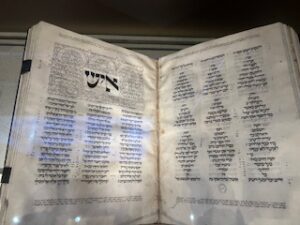
This Bible was from Germany circa 1300 A.D.
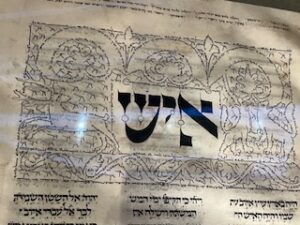
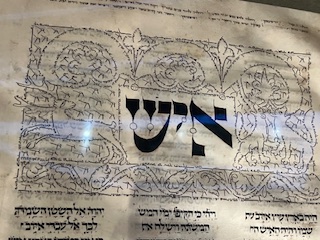
It is opened to Job chapter one, where the first word of the book Ish (“man”) is dramatically written.
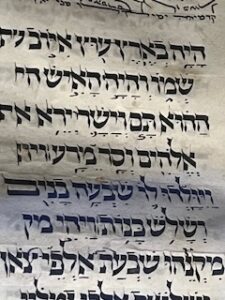
Again, the vowel points are clearly visible as one reads from the first verse following: “was in the land of Uz Job his name…”
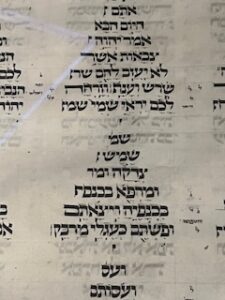
As was common through the Masoretic period, the marginal notes (masoreh) were ornate and decorative, in this case taking the shape of intricate geometric designs.
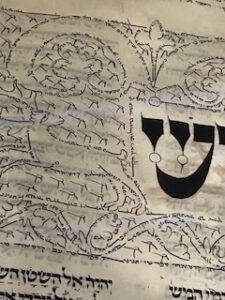
Another fascinating aspect of this manuscript is the masoreh at the heading of the book, wherein the Hebrew sentences are written into pictographs, pictures depicting a scene. To the left of Ish (“man”) a stag fleeing for its life is visible.
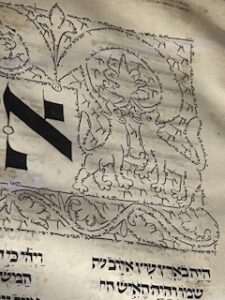
To the right of Ish (“man”) are two wolves or hounds howling and panting in pursuit of the stag.
We have proposed in some of the other articles on this blog that it is biblically reasonable that Job was the first book of the Bible written, even before Moses began to pen the Torah. If that were the case, then “man” would be the first word that the Holy Spirit breathed out during the inspiration process. The Bible is God’s gift to man, is the book for man, and points all men to the Son of Man, the Lord Jesus Christ. We rejoice as David did, when he wrote, “Thy testimonies have I taken as an heritage for ever: for they are the rejoicing of my heart” (Psalm 119:111 KJV). We thank God for His matchless word, the Bible, and we are grateful to the Grolier Club and the Jewish Theological Seminary for making this display publicly available to provide our church with an unforgettable experience to see the demonstration of God’s promise of preservation (cf. Psalm 12).